
Pradhan Mantri Bhartiya Janaushadhi Pariyojana (PMBJP)
Advancing Affordable and Equitable Healthcare in India
Key Takeaways
|
Healthcare affordability remains one of the most pressing challenges in India. Medicines account for a significant portion of household out‑of‑pocket expenditure, often pushing vulnerable families into financial distress. Branded medicines, though therapeutically equivalent to their generic counterparts, are sold at much higher prices, creating inequity in access. To address this, the Government of India launched the Pradhan Mantri Bhartiya Janaushadhi Pariyojana (PMBJP), a flagship scheme designed to provide quality generic medicines at substantially reduced prices through a nationwide network of Jan Aushadhi Kendras (JAKs).
This initiative has become a cornerstone of India’s healthcare reforms, combining affordability, accessibility, and inclusivity. With over 18,000 Kendras already operational and a target of 25,000 by March 2027, PMBJP is reshaping the healthcare landscape by ensuring that essential medicines reach even the remotest corners of the country.
Objectives of PMBJP
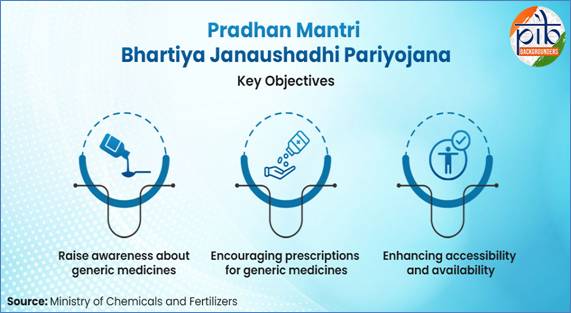
The scheme is built on three core objectives:
-
-
- Raising awareness about generic medicines and their therapeutic equivalence.
- Encouraging prescriptions of generics by healthcare professionals.
- Enhancing accessibility through a robust distribution network.
-
These objectives are pursued through outreach campaigns such as Janaushadhi Saptah, which in 2026 included health check‑up camps across 250 locations, culminating in the observance of the 8th Janaushadhi Diwas. The theme, “Janaushadhi Sasti Bhi, Bharosemand Bhi, Sehat Ki Baat, Bachat Ke Saath”, captured the essence of the programme: affordable, trustworthy, and health‑focused medicines that also save money.
Quality Assurance
A critical feature of PMBJP is its uncompromising commitment to quality. Medicines are procured only from manufacturers compliant with WHO‑GMP standards, ensuring global benchmarks of safety and efficacy. Each batch undergoes rigorous testing in NABL‑accredited laboratories, and distribution to Kendras occurs only after full compliance with prescribed parameters. This system builds public trust in generics, countering the perception that lower prices mean lower quality.
Scale and Reach
The scheme’s footprint is impressive:
-
- 18,000+ Kendras operational across India.
- 2,110 medicines and 315 surgical items covering 29 therapeutic categories.
- Daily footfall of 10–12 lakh citizens availing affordable medicines.
- Savings of 50–80% compared to branded alternatives.
By June 2025, Jan Aushadhi medicines worth ₹7,700 crore (MRP value) had been sold, generating estimated savings of ₹38,000 crore for citizens. This scale demonstrates the scheme’s tangible impact on household healthcare expenditure.
Franchise‑Based Expansion
To achieve the ambitious target of 25,000 Kendras by 2027, the government has adopted a franchise model. Applications are invited from individuals, NGOs, trusts, firms, and private entities through the PMBI portal. This inclusive framework ensures participation from diverse stakeholders, enabling expansion into urban, rural, and remote areas. The model not only widens access but also fosters entrepreneurship, particularly among women, SC/ST communities, Divyangjan, and veterans, who receive special incentives up to ₹2 lakh.
Citizen‑Centric Initiatives
Janaushadhi Suvidha Sanitary Napkin
Introduced in 2019, this initiative provides oxo‑biodegradable sanitary napkins at ₹1 per pad, addressing menstrual health and affordability. By January 2026, over 100 crore pads had been sold, with 22.5 crore in FY 2025‑26 alone. Distributed through 18,000 Kendras, the initiative supports both women’s health and environmental sustainability.
Jan Aushadhi Sugam Mobile App
Launched in 2019, the app enhances digital access to affordable healthcare. Key features include:
-
- Geolocation‑enabled identification of nearby Kendras.
- Search and real‑time availability of medicines.
- Comparative price analysis between generics and branded drugs.
Available on Android and iOS, the app represents a significant step in digital governance, empowering citizens with transparency and convenience.
Strengthening Last‑Mile Access
PMBJP’s strategy goes beyond expansion—it focuses on sustainability and integration:
-
- Expanded product basket: Inclusion of nutraceuticals, protein powders, glucometers, and supplements.
- Integration with public health infrastructure: Rent‑free premises in government hospitals to increase accessibility.
- Performance‑linked stocking norms: Mandatory stocking of 200 fast‑moving medicines to qualify for incentives.
- Cooperative sector participation: Leveraging PACS networks to establish Kendras in rural areas, benefiting over 13 crore farmers.
These measures ensure Kendras remain viable, accessible, and responsive to community needs.
Kendras at Railway Stations
Recognizing the importance of transit hubs, 116 Kendras have been established at railway stations as of January 2026. This initiative benefits migrant workers and low‑income travelers, ensuring timely access to affordable medicines during journeys. It exemplifies the scheme’s focus on last‑mile delivery.
Institutional and Regulatory Requirements
Eligibility to open a Kendra includes:
-
- Minimum space of 120 sq. ft.
- Pharmacist registered with the State Pharmacy Council.
- Category‑specific documentation for SC/ST/Divyangjan applicants.
These requirements balance accessibility with professional standards, ensuring Kendras are both inclusive and medically reliable.
Incentives and Entrepreneurship
PMBJP promotes inclusive entrepreneurship through structured incentives:
-
- Normal Incentive:
- 20% trade margin on MRPs.
- Monthly incentives up to ₹20,000, capped at ₹5 lakh.
- Special Incentive:
- Normal Incentive:
-
- ₹2 lakh one‑time grant for women, SC/ST, Divyangjan, and entrepreneurs in aspirational districts or remote regions.
- ₹1.5 lakh reimbursement for furniture and fixtures.
- ₹0.5 lakh reimbursement for IT equipment.
This framework ensures financial viability while encouraging participation from marginalized groups.
Supply Chain and Logistics
The Pharmaceuticals and Medical Devices Bureau of India (PMBI) has modernized supply chain management with IT‑enabled systems. Key features include:
-
- Five central warehouses and 41 distributors nationwide.
- Incentivized stocking of 200 high‑demand medicines since 2024.
- Continuous monitoring of 400 fast‑moving products.
- Digitized demand forecasting for efficient procurement.
This robust logistics backbone ensures uninterrupted availability of medicines across Kendras.
Impact and Significance
PMBJP’s impact can be summarized across three dimensions:
-
- Economic Relief: By reducing medicine costs by up to 80%, the scheme has saved citizens tens of thousands of crores, directly alleviating financial stress.
- Social Inclusion: Special incentives empower women, SC/ST, Divyangjan, and rural entrepreneurs, fostering equitable participation.
- Public Trust: Rigorous quality assurance and awareness campaigns have built confidence in generics, challenging entrenched biases toward branded medicines.
Challenges Ahead
Despite its success, PMBJP faces challenges:
-
- Ensuring consistent supply in remote areas.
- Overcoming resistance from sections of the medical fraternity reluctant to prescribe generics.
- Sustaining awareness campaigns to counter misconceptions.
- Expanding product diversity to meet evolving healthcare needs.
Addressing these challenges will be crucial for achieving the 2027 target and ensuring long‑term sustainability.
Conclusion
The Pradhan Mantri Bhartiya Janaushadhi Pariyojana represents a transformative step in India’s healthcare journey. By combining affordability, accessibility, and inclusivity, it has emerged as a powerful instrument of social equity. Beyond reducing costs, PMBJP empowers citizens, fosters entrepreneurship, and strengthens trust in generics. With its expanding footprint, digital innovations, and citizen‑centric initiatives, the scheme is poised to become a cornerstone of India’s commitment to universal healthcare.
As India moves toward the 2027 target of 25,000 Kendras, PMBJP will continue to reinforce the principle that healthcare is not a privilege but a right—accessible, affordable, and equitable for all.
Source: PIB
https://www.pib.gov.in/PressNoteDetails.aspx?id=157711&NoteId=157711&ModuleId=3®=3&lang=2
Video Source: Pradhan Mantri Bhartiya Janaushadhi Pariyojana (
